


Another Spring – Bioweapons and Naming a Viral Disease
What a 2022 Serbian Documentary Does not Tell Us About Yugoslavia’s Red Plague of 1972
-
The Eternal Scapegoat and Yugoslavia’s “Red Plague” of 1972
 “When the Christians were exhausted from war,” he wrote, “God saw fit to send the Indians smallpox, and there was a great pestilence in the city….” (Francisco de Aguilar, Dominican friar in the 16th century)
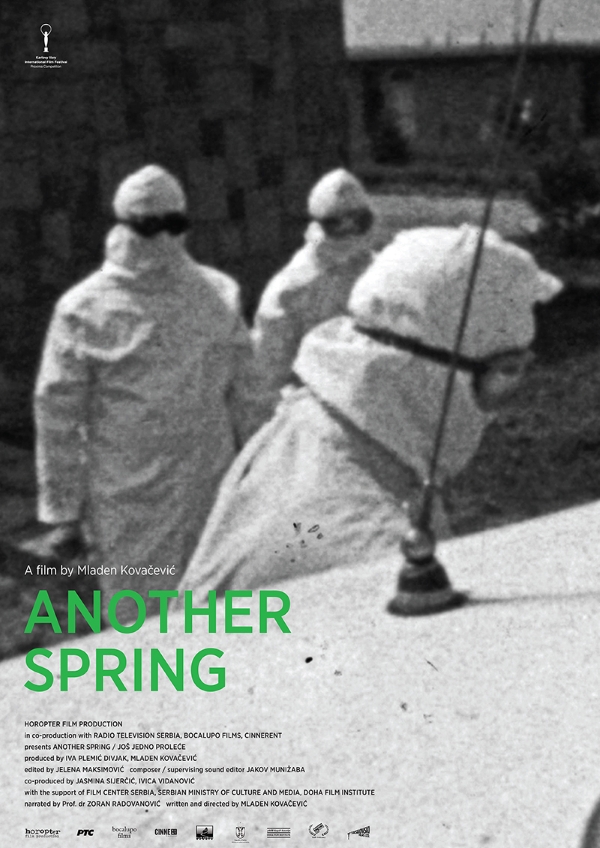
 I saw Another Spring / Još jedno proleće (Mladen Kovačević, Serbia/France/Quatar 2022), on the smallpox epidemics in Yugoslavia of 1972 at the Karlovy Vary International Film Festival (KVIFF). It was hailed as a "gripping archival documentary, aptly described by its creators as a medical thriller." (Janković 2022) Gripping it was indeed, but the question is why?
Sitting in the dark cinema, I was reminded of 1940s propaganda films, cinematic hate campaigns directed against ‘inner’ enemies of the state. The most blatant historical example was the "documentary film" Der ewige Jude / The Eternal Jew (Fritz Hippler, Deutsches Reich, 1940) which, with the help of parallel film montage, likens “Non-Aryans” to rats infesting sanitary Germany.
But there was more. The slowed down black and white archival footage and the eerie soundtrack pointed to the horror genre. One of its early milestones undoubtedly was Nosferatu – Eine Symphonie des Grauens (Nosferatu: A Symphony of Horror, by F.W. Murnau), a 1922 German horror film about a visitor from the South-East of Europe who preys on a Northern woman, drinking her blood. Murnau’s silent film is loosely based on Bram Stoker’s novel Dracula (1897), with the main difference that the vampire from the Balkans visits not Victorian England but Germany. The grotesquely elongated figure with overlong nails and teeth in Nosferatu is a visual augmentation of the novel’s xenophobia, developing its antisemitic leanings as rodent features. Jamil Khader in his article “Humanizing the Nazi?” reminds us that the “trope of the Jew as a vampire, the blood-sucking Nosferatu, occupied a central position in the anti-Semitic Nazi racial ideology.” (Khader 2011: 136)
 Indeed, the expressionist silent film Nosferatu – A Symphony of Horror could well have been an inspiration for the “documentary” Der ewige Jude. Moreover, in the silent film a van Helsing-like Paracelsus figure demonstrates predators in nature (spiders, fly traps), the vampire Nosferatu travels North to acquire a property in a German town, brings on his ship coffins filled with rats, which infect the town with plague (pestis). And last but not least, a Jewish actor, Alexander Granach, was cast as Knock, Dracula’s associate in Germany.
The “Red Plague” (variola major), or smallpox, which we are confronted with in Another Spring, is a disease with symptoms lending itself to similarly effective imagery of body horror, the pornography of lesion having a distinct ‘yuck factor’. Blisters covering the whole body, or in the case of the rare hemorrhagic form of the plague (also called “black pox”), bleeding under the skin. Patients usually do not survive the latter, even if vaccinated – which was the documented case of Kosovar teacher Latif Mumdžić in spring 1972. Supposedly, he caught the infection from an Albanian Muslim pilgrim, who later was declared Patient Zero, having contracted the viral disease on his journey to Mecca.
As Eric Gordy, remarked, “some of the elements of the story are ‘too good to be true’ (an Albanian was the first person to be infected? Religious as well? And went on a religious pilgrimage?).”[1]
However, before examining the context of the pandemic, let me start with a philological aside which will lead us straight into the prejudice factory which in this case is grounded in language.
Naming a Viral Disease: “Arapske Boginje”
On a Serbian portal for medical advice called “Symptoms” which I visited on 10 December 2022, all current Serbian synonyms of the term smallpox are enumerated – “Variola (velike boginje, crne boginje, arapske boginje)”, the last in a literal translation would have to be rendered in English with the hostile conjunction “Arab pox.” I was surprised that one of the expressions used in Serbian for smallpox until today still seems to be “arapske boginje”, linguistically ascribing the provenience of the disease to the “Arabs”.
As it transpired, this vernacular term was used in the past even in scientific publications which came out at the time of the Yugoslav pandemic, such as the proceedings of an international symposium on Endemic Nephropathy in Niš where on page 9 we can read about “the epidemic of variola (‘Arabian’ pox) that reigned in the region of Brestovac in 1910-11.” (published by the University of Niš, 1971)[2]
Another, more recent source is the book Variola vera. Virus, epidemija, ljudi. In this publication of January 2017, Dr Zoran Radovanović devotes a section to the Yugoslav pandemic which stood at the beginning of his career. He recalls how he coordinated the fight against the disease in Belgrade after March 22, 1972. The passage in this book contains the same term which is given even more prominence, introduced as the first synonym:
Serbia. In our classic textbook on infectology there is a lemma: "Smallpox - Variola vera", and as synonyms the terms Arab pox and black goats are listed. One is reminded that the term boginja comes from the German word Poken [sic!], and variola from the Latin word varus = knot, bump (the translation could also read pox, pimple, sore, ulcer). (Radovanović 2017: 22)[3]
Whether “Arab pox” or the “Pocken/boginje” imported from Germany – linguistically smallpox is associated with foreign intrusion.
A Patient Zero Suffering from Variola Sine Eruptione
During the coronavirus pandemic, it was all about demonstrating how a well-organized state can manage and even stop epidemics. In the region, people often referred to Tito’s Yugoslavia as a better-functioning state in this regard, especially in comparison to its successor states. This sentiment forms an important part of the context for the creation of the film Another Spring and explains why it drew such wide attention.
Another Spring conveys that thousands died in Yugoslavia that spring, but in reality, 175 people fell ill and the number of deaths did not exceed 40 — some sources say 35. The outbreak was also limited mainly to Kosovo and Metohija, with additional infections among medical personnel in Belgrade. One wonders why Another Spring endeavours to persuade us that smallpox was close to wiping out the people(s) of Tito's Socialist Federal Republic of Yugoslavia. With the help of authenticating oral histories and popular science books on the outbreak, the film not only “identifies” but also names a Patient Zero using “archival footage” of the supposed culprit: Ibrahim Hoti, an Albanian Muslim from the former Socialist Autonomous Province of Kosovo. He allegedly imported the disease from his hajj and infected Mumdžić, who was then transported to Belgrade, where he died. His misdiagnosis — an anaphylactic reaction to penicillin — and the absence of quarantine measures led to the infection of many people in the hospital.
While Mumdžić’s illness is fact, Hoti's smallpox could well belong to the realm of fiction, as Dr. Radmilo Petrović (* 1935), retired epidemiologist of the Torlak Institute of Virology, Vaccines and Sera, claimed. Petrović was involved in fighting smallpox – differently from other doctors spinning their variola narratives, he was not an administrator in the capital but was taking samples from patients in all parts of Yugoslavia, working on the ground. In March 2017 Petrović issued a statement for the morning programme of the Serbian TV channel RTS in which he expressed doubts that “the infection could have happened in a mosque or a market in Iraq, as stated in official reports.” (see also Petrović 2017) Later he said that it was the ”government who dictated” who was to be blamed for the outbreak (“Određen je kao ‘nulti’ po diktatu vlasti.” Petrović 2021).
The official 1973 report by Colonel B. Arsić, S. Borjanović, and S. Litvinenko, claimed that epidemiological and serological data pointed to “Ibrahim H.” as “index case”. However, as a recent scientific article by authors from Serbia and Montenegro (“Smallpox as an actual biothreat: lessons learned from its outbreak in ex-Yugoslavia in 1972”), published in the peer-reviewed Italian Open Access journal Annali dell'Istituto Superiore di Sanità states, the findings indeed just indicated a “probability”:
The results showed significant differences of positive findings in the sera of Ibrahim H. compared with the serum of other pilgrims. Therefore, it was considered that Ibrahim H. as an index case was a probable source of infection for the next 9 cases. (Ristanović, Gligić, Atanasievska, Protić-Djokić, Jovanović and Radunović 2016, p. 590).[4]
Until today it remains unclear how Latif Mumdžić who developed the most severe form of hemorrhagic smallpox could have been infected by Ibrahim Hoti who was asymptomatic. According to the article “Variola virus (Smallpox)” in the John Hopkins Center for Health Security website, “transmission of clinical smallpox had not been documented for variola sine eruptione”.
Petrović gives more arguments for his hypothesis: Hoti had been vaccinated in Skopje, he had no symptoms and “he did not infect any household member from the large family he lived with [...] Therefore, the official version that he was the ‘case zero’ of smallpox is not correct.” (Petrović 2017), coming to the conclusion: “All this indicates that Ibrahim Hoti did not bring the smallpox virus to Yugoslavia.”
But even if he had – would it be a reason to exhibit his face and name in 2022 as the spreader of the infection of 1972?
Since the film audience cannot verify the epidemiological findings, an “archival documentary” on the medical history of Yugoslavia should at least inform them that there is no hard proof of a Patient Zero importing “Arab pox” from Mecca and that even among Serbian doctors there is no consent concerning the spreader, supposedly a pilgrim. In hindsight, it is disappointing that Petrović is not part of the documentary Another Spring, so a genuine debate would have been possible. This role is allotted to a different doctor, who re-confirms the official 1972 version of the outbreak in Kosovo as formulated by the Yugoslav authorities.
It is only at the film’s conclusion that we learn the voice-over was provided by the author of the aforementioned book, “Dr Zoran Radovanović, Serbia's foremost authority on epidemics” (Petkovic 2022). His disembodied narration functions as an acousmatic voice — one that projects authority while remaining unseen. One might also argue that it is a voice unburdened by full accountability for the film’s underlying message, which subtly places blame on the othered pilgrim for the infection of Yugoslavia. In Another Spring, Ibrahim Hoti is cast as the embodiment of the Eternal Muslim.
It appears that documentary filmmaker Kovačević did not undertake his own research on the smallpox outbreak but instead placed complete trust in Radovanović, ultimately choosing him as “the only narrator of the film.” After spending a week in the studio, they recorded twenty hours of audio material. “He is a reliable narrator who has revisited his memories countless times and confronted them with facts, and these memories are complemented by archival interviews,” the director details. “He tells the official version of events, but this is not a polemic or historical film; it's an intimate reminiscence, especially from the perspective of this new pandemic, about events from the early 1970s.” (Kovačević 2022).
The framing of Radovanović’s voice as an “intimate reminiscence” is not only misleading but strategically obfuscating. Although presented as a personal account, Radovanović was not an eyewitness to the key moments of the 1972 outbreak. His authority is retrospective and institutional, not experiential. The voice-over — acousmatic, authoritative, and visually disembodied — functions as a narrative device to consolidate control while preserving the illusion of emotional authenticity. This technique is characteristic of both state documentary practices, where pseudo-intimacy often serves to assert ideological coherence while appearing to offer subjective access.
There may also be another reason why the inclusion of a dissenting medical voice, such as that of Dr Petrović, was unwelcome. In 2017, Petrović publicly proposed that the 1972 outbreak might not have been of natural origin. While this hypothesis has largely been dismissed as conspiratorial, it raises unresolved questions about the outbreak’s progression — including the virus’s sudden appearance in maternity wards, the presence of a rare hemorrhagic form of smallpox, and inconsistencies in official accounts. The absence of such alternative interpretations in Another Spring reinforces its mono-narrative structure. Rather than embracing the ambiguities and uncertainties that historical inquiry often demands, the film opts for a single, ostensibly stable truth.
This narrative choice reveals a deeper biopolitical logic. Produced during the COVID-19 pandemic, Another Spring functions not only as a retrospective on the 1972 epidemic, but also as a contemporary parable about epidemiological governance. By highlighting Yugoslavia’s capacity to contain a deadly disease, the film implicitly offers a reassuring image of past state competence in contrast to the perceived failures of its successor states. In doing so, it revives historical discursive frameworks in which illness is treated not merely as a biological threat, but as a social and moral contamination — a vector for projecting anxiety, blame, and difference (Sontag 2001).
In this context, the figure of Ibrahim Hoti is crucial. Framed as “Patient Zero,” the Muslim pilgrim from Kosovo is positioned not simply as the index case of the outbreak, but as the symbolic outsider through whom national vulnerability is both narrated and contained. The film’s reliance on Radovanović’s voice — unchallenged and institutionally sanctioned — enables this racialised logic to operate under the guise of scientific neutrality. As Susan Sontag argued, disease is rarely just about the body; it becomes a metaphor for social disorder, laden with moral and political meaning.
Another Spring, then, participates in a longer historiographical tradition — one that privileges narrative cohesion, centralised authority, and the erasure of plural memory. Its invocation of “intimacy” is not an opening toward vulnerability or dialogical truth, but a rhetorical device that shields the film’s underlying message from critical interrogation.
Had Another Spring critically engaged with Petrović’s suggestion that the 1972 smallpox outbreak may have been the result of biological terrorism — a line of reasoning not uncommon in both scientific and security contexts when no definitive index case can be established — the documentary might have evolved into a compelling medical and political thriller. One is left to wonder whether Kovačević initially envisioned a more investigative approach, but during the pandemic, found himself constrained by the climate of national sensitivity and the lack of institutional support or funding within his home country.
A recent article by Bosnian cultural historian Elvir Duranović (2020) reminds us of the fact that the Islamic Community of SFR Yugoslavia (Vrhovno islamsko starješinstvo), due to the rising Islamophobia in Yugoslavia in spring 1972, felt obliged to investigate the pilgrims and came to the conclusion that they were all vaccinated and none of them was ill with smallpox.
The smallpox epidemic, the largest in Europe after the Second World War, broke out in March 1972 in SFR Yugoslavia. The state authorities, and among them the media, identified Ibrahim Hoti from Kosovo as the source of the infection, who, just before the appearance of the infection, was on the hajj, to which he travelled by bus, organised by the Islamic Community organisation. Since certain media outlets wrote in an extremely hostile manner about the hajji as a source of infection, attacking Islam and Islamic values, the Supreme Islamic Eldership conducted an internal inquest through which they learned that all the hajjis had been vaccinated against smallpox and that none of them got sick after returning from the hajj. Relying on the reports of its authorities, the Islamic community in SFRY never admitted that any of the pilgrims was the source of the infection.[5]
Of course, we can choose not to believe this inspection by an Islamic institution as well as reject the hypothesis of Petrović – but there is another historical context of the early 1970s which plays a role if we want to understand the political climate in the country and in Eastern Europe at the time of the outbreak.
Biological Weapons Against Yugoslavia?
“Even the Yugoslav president Tito didn't make a single public appearance or a statement during the smallpox outbreak.” (Kovačević 2022)
The Center for Health Security in the USA states: “Smallpox is considered one of the most serious bioterrorist threats. It was used as a biological weapon during the French and Indian Wars, (1754 to 1767) when British soldiers distributed smallpox-infected blankets to American Indians. In the 1980s, the Soviet Union developed variola as an aerosol biological weapon and produced tons of virus-laden material intended for release via intercontinental ballistic missiles.”
This might be true, but who could have been interested in attacking or destabilising Yugoslavia in 1972 with a viral attack, dangerous for the whole region?
There are two reasons why the hypothesis of the intended release is not as far-fetched as one might think. There is a documented pre-history to the 1972 outbreak. The idea of infecting the Yugoslav leader Tito, whose political stance of independence and plan for a Balkan federation – including Bulgaria – greatly annoyed Stalin, as it reduced Moscow’s control over the region. In his Short History of Biological Warfare, Seth W. Carus mentions a plot of infecting the Yugoslav leader with plague bacteria (the same which had come with Nosferatu from the Balkans to Germany):
We do know that the KGB viewed pathogens as possible weapons for targeted killing. Documents uncovered after the collapse of the Soviet Union reveal that Joseph Stalin instigated a plot to assassinate Josip Broz Tito and that one of the options was to infect him with Yersinia pestis, the organism that causes plague. Stalin died before the assassination plot was finalized, and it was abandoned. (Carus 2017, 34-35)
This information surfaced in the 1990s when Russian historian Dmitrii Volkogonov revealed the story of “a plot codenamed 'Scavenger' [...], hatched during a meeting of senior KGB officers in Vienna in 1952”:
The officers wrote to Stalin nominating a man called Yosif Grigulievich or 'Max', a Soviet citizen who passed himself off as a Costa Rican diplomat, for the job of administering the plague, and suggested three ways in which he might do this. He could seek an audience with Tito and, at close quarters, shoot a deadly pellet into him using a 'noiseless mechanism hidden in his suit'. He could follow Tito on a trip to London and, at a reception at the Yugoslav embassy there, shoot him while throwing tear-gas bombs to distract the other guests. Or he could send Tito a present – for example a jewellery box which, when opened, would squirt the poison into the Yugoslav leader's face.
'This all sounds like the plot of a racy detective thriller,' Mr Volkogonov said. 'But it's not the scenario for an adventure film, it's the authentic thinking of the leadership of the Ministry for State Security.’[6]
Grigulevich was a Soviet illegal operative active in Europe and Latin America between 1936 and 1953. Born Juozas Grigulyavičius in 1913 in Vilnius into a Karaite family, he became one of the most enigmatic figures of Soviet foreign intelligence. According to Andrei Znamenski (2017: 315), he was involved in the assassination of dissident Spanish communist Andrés Nin in 1938, later posed as the Costa Rican ambassador to the Vatican (1949–1952), and in 1952, planned “an abortive project to assassinate Joseph Bros Tito”. He had earlier participated in the failed 1940 attempt to kill Leon Trotsky in Mexico, alongside the painter David Alfaro Siqueiros; as Znamenski notes (ibid., 328), the “detailed script of a projected cavalier attack on Trotsky’s compound in Mexico caught the attention of Lavrentii Beria.”[7] The boundaries between Grigulevich’s operational successes and (alleged) failures remain opaque. He was nonetheless decorated for his service and continued to be celebrated in post-Soviet memory culture, appearing, for instance, in the 2021 video exhibition Foreign Intelligence Service: From the Past to the Future, marking the centenary of Russian foreign intelligence in Moscow.[8]
A translated MGB USSR document, published by the Wilson Center, sheds further light on the planned assassination of Tito. The first version of the operation — referred to as a “terakt” (terrorist act) — included a striking detail: the Soviet services intended to use the agent codenamed “Max” as an unwitting courier of the bacterial agent, without informing him of the nature of the substance he was carrying.
According to this document, the first option for this terrorist act against Tito contained an interesting detail – the plan was to use “Max” as the unwitting messenger for the bacterial substance without telling the agent of its nature.
To order "Max" to arrange a private audience with Tito, during which a soundless mechanism concealed in his clothes would release a dose of pulmonary plague bacteria that would guarantee death to Tito and all present. "Max" himself would not be informed of the substance's nature, but with the goal of saving "Max's" life, he would be given an anti-plague serum in advance.[9]
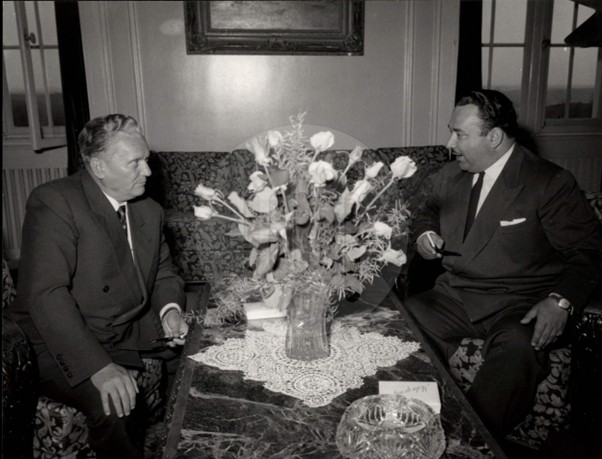
Due to his “cosmopolitan” background, Grigulevich in 1952 in Stalin’s eyes must have been seen as expendable, rendering his attack on Tito a potential suicide mission – while his Mexican wife was held hostage in the USSR (Znamenski 2017: 329). The agent, after Stalin’s death in March 1953, was called back to Moscow, had to leave the service, and became a scholar and writer of popular ZHZL biographies of Bolivar, Che Guevarra and the likes. Tito was spared the virus at that point, and could feel at ease – which might explain the relaxed atmosphere at “close quarters” with the Soviet agent on the way out in spring 1953 in this photo.
On the photo, we see a scene showing them “at close quarters”: “Yugoslav head of state, Marshal Tito (left), receives the Costa Rican ambassador, Teodoro B. Castro (right), on April 27, 1953.” Wikipedia explains that “Ambassador Castro was in fact a Soviet illegal agent, Iosif Grigulevich, who, under orders from Stalin and the NKVD, was plotting to assassinate Tito.” The same photo is also on the website Muzej istorije Jugoslavije, as “Prijem Teodora Kastra, poslanika Kostarike”, however, without commentary:
http://foto.mij.rs/site/gallery/808/photo/45
https://en.wikipedia.org/wiki/Iosif_Grigulevich%23/media/File:Grigulevich-Tito.jpg [6 January 2023]
Roughly two decades later, the tension between Moscow and Belgrade re-emerged. The year preceding the outbreak of smallpox had been a difficult one for Yugoslav-Soviet relations, when “the Soviets considered interfering in Yugoslav affairs – if not outright military intervention.” On April 30, 1971, Leonid Brezhnev had phoned Tito, expressing “readiness to ‘assist’ Tito in quelling domestic disturbances”, similarly as it happened in Prague in 1968.[10]
Incidentally, only a few months after this call, tests involving aerosolised smallpox were conducted in a Soviet laboratory on an island in the Aral Sea, near Aralsk (today Aral, Kazakhstan). As Togzhan Kassenova (2020) has shown in her studies of the Aralsk outbreak, the episode was long suppressed in Soviet public discourse, despite its potentially grave epidemiological implications. The American scientist Alan Zelicoff MD in 2003 published a “forensic epidemic analysis”[11] of this outbreak which at the time was hushed up by the Soviet Union:
During the summer of 1971, a previously unreported outbreak of smallpox occurred in Aralsk, a city of approximately 50,000 people on the northern shore of the Aral Sea in the Soviet republic of Kazakhstan. It is now clear that senior Soviet leaders, starting with KGB chief Yuri Andropov, suppressed the reporting of this outbreak, possibly to protect the top-secret Soviet biological warfare (BW) program. In so doing, they put the population of Central Asia at risk of a potentially catastrophic epidemic.[12]
Zelicoff (2003: 979) is of the opinion that “The failure of the Soviet Union to notify the WHO of the 1971 outbreak suggests a sinister source for the epidemic.”
In his commentary on Alan Zelicoff’s article, Dr. Serguei Popov (George Mason University), a former scientist in the USSR, stresses that the Soviet biological warfare programme was shrouded in secrecy and supported by an extensive network of deception: “The highly classified nature of the Soviet biological warfare program makes it extremely difficult to collect direct evidence about its activities. One also has to take into account the strong counterintelligence efforts undertaken by the Soviet security apparatus to provide the program with innocuous ‘cover stories’.” Notably, one early Soviet case of smallpox was officially attributed to contamination from an imported oriental rug.
Against this backdrop, Tito had every reason — both political and diplomatic — to sweep the Yugoslav “mini outbreak,” which had originated in Kosovo, discreetly under the carpet.
Soviet-Yugoslav Histories of Bio-Weapons
One of the scenarios detailed in declassified Soviet documents was the idea of sending him a sealed box that would release a bacterial agent upon opening.[13] These plots, however, even in 1953 seemed hazardous. As we have seen in the case of COVID-19, the outbreak of an epidemic disease cannot be contained easily, it spreads and kills indiscriminately, overcoming state borders with ease. Furthermore, the technology of a targeted infection was unreliable since the bacterial spray attack proved technically difficult.
Ken Alibek, once at the helm of the Soviet germ warfare programme, characterises the effectivity of infectious particles as dependent on its aerosol dispersion:
Throughout the Cold War, we considered viruses to be among the most valuable munitions in our arsenal. Their ability to infect vast numbers of people with an infinitesimal number of particles made them ideal weapons for modern strategic warfare. As our technical ability to create aerosols improved, we found they could be used to greater effect than some bacteriological munitions, especially in the case of diseases spread through direct personal contact. Fewer than five viral particles of smallpox were sufficient to infect 50 percent of the animals exposed to aerosols in our testing labs. To infect the same percentage of humans with anthrax would require ten thousand to twenty thousand spores. For plague, the comparable figure is fifteen hundred cells. The differences in quantity are too minute to be discernible to the naked eye, but they are significant if you are planning attacks on a large scale. (Alinbek 2008: 115)
Alibek (2008: 172) also gives more specific information on the “powdered version of plague manufactured for use in a tiny toiletry container” in the 1940s in “Lab 12”, established in the 1920s by Genrikh Yagoda. Allegedly it was the one intended for Marshal Tito.
In his book Biohazard Alibek acquaints us with the astounding early history of smallpox virus production in the 1940s:
In 1947, the Soviet Union established its first smallpox weapons factory just outside the ancient cathedral town of Zagorsk, forty minutes’ drive northwest of Moscow. Zagorsk (now Sergiyev Posad) is the site of the walled fourteenth-century Trinity – St. Sergius Monastery, one of the most revered places in the Russian Orthodox religion. (Alibek 2008: 111)
The Kazakh-American microbiologist, and biological warfare administrative management expert, qualifies the smallpox virus as a continuously developed weapon in the Soviet arsenal:
Where other governments saw a medical victory, the Kremlin perceived a military opportunity. A world no longer protected from smallpox was a world newly vulnerable to the disease. In 1981, Soviet researchers began to explore what the Kremlin hoped would be a better version of a smallpox weapon that had been in our arsenal for decades. The work was at first cursory. Military commanders were reluctant to devote energy and resources to an enterprise that promised no immediate results. The Soviet Union, they reasoned, had already gone further with smallpox weapons than any other country. (Alibek 2008: 111)
Alibek also explained how a more potent strain of the virus, called India-1967, was won for a Soviet lab:
In 1959, a traveler from India infected forty-six Muscovites with smallpox before authorities realized what had happened. […] The strain of Variola major in his system was so virulent that an epidemic was only narrowly averted. Partly in response to this incident, the Soviet government sent a special medical team to India to help purge the virus from the subcontinent. KGB agents went with them.
They returned to Russia with a strain of Indian smallpox excellently suited to weapons production. It was highly virulent and was stable enough to retain its infectious qualities over time. This meant that, with the proper additives, it could be stored longer than the strains in Soviet stockpiles. Within a few years, India’s unwitting gift became our principal battle strain of smallpox. It was dubbed India-1967, to commemorate the year of its isolation. In our secret code, it became India-1.
In the 1970s, smallpox was considered so important to our biological arsenal that the Soviet military command issued an order to maintain an annual stockpile of twenty tons. The weapons were stored at army facilities in Zagorsk. Annual quotas of smallpox were required as it decayed over time. We never wanted to be caught short. (Alibek 2008: 112)[14]In his survey of the history of bio-weapons of Marek Naczyk points out that the interest in viral bioweapons was not limited to Soviet science, but was also explored in the West:
Viruses have attracted the attention of bioweaponeers for decades. During World War II the Western allies explored the possibility of weaponizing several viral diseases, including Venezuelan equine encephalitis and smallpox. American, Canadian, and British scientists found to their frustration that viruses were far more difficult to manipulate than bacteria. Since they cannot grow on their own, they must be nurtured in living cells or tissues inside a sterile laboratory environment. (Naczyk 2021: 114)
Interestingly, Naczyk stresses the difference between bacteria and viruses, discarding smallpox as less effective:
A large body of Western scientific opinion considers Variola major an unlikely weapon, despite its contagiousness. Smallpox does not normally occur in animals, though monkeys can contract it without spreading it to others. Humans are the virus’s only natural hosts. There is no way, therefore, for the disease to propagate in nature. Some scientists argue that an outbreak among humans would be contained through quarantine and vaccination before it could develop into an epidemic, as happened in Moscow in 1959. (Naczyk 2021: 113)
Smallpox, in particular, was propagated in embryonated chicken eggs or in live animal tissue — techniques that required significant laboratory infrastructure but enabled relatively compact and covert production. (Naczyk 2021: 114) This biological specificity made viral bioweapons technically more challenging to develop than bacterial ones, but also harder to detect and attribute if deployed covertly. In a 2007 interview, a Russian general reportedly referred to smallpox as “not a bad weapon,” underscoring not only its lethality and low cost, but also the difficulty of tracing its source.[15]
Exactly these characteristics — high contagion paired with exclusive human-to-human transmission — may have made smallpox of particular interest in scenarios requiring a limited but high-impact outbreak capable of sowing unrest within Yugoslavia, especially in a region such as Kosovo. Crucially, such an outbreak could be managed nationally through quarantine and ring vaccination, without escalating into a continent-wide pandemic. In 1972, Yugoslavia relied in part on vaccine supplies from the USSR — a detail that positioned the Soviet Union as both a critical source of aid and, in more speculative interpretations, a potential originator of the outbreak.
Variolation from the „East of the East“
"It comes from an Islamic country that we regard as backwards — 'How could they have the answer to smallpox?' — and also it was something done by women, which is bad." (Isobel Grundy in Brumfiel 2021)
In Another Spring, Mumdžić and Hoti, both are used to frame the renewed historical narrative of the socialist country’s heroic reaction to the last major outbreak of the smallpox epidemics which supposedly started after a journey to the Middle East, with the virus in the form of saliva – "perhaps" as the film suggests – travelling in an oriental flute which Hoti brought home as a souvenir to his village, Dejnë / Danjane.
In the end of Another Spring, we see a clip of a sombre looking Hoti, “archival”, of course, and we learn from another ‘source’ that he – marked as the ancestor of all contemporary ‘anti-vaxxers’ – supposedly had wiped off the vaccine with ethanol because somebody in the waiting room told him that he would not need the vaccine. The ‘source’, however, is a newly recorded soundtrack for the film. Together with Yugoslav era audiovisual documents showing Hoti, his surroundings and Mumdžić’s family, they form the composite image of the Eternal Muslim. According to Duranović (2020) the Islamophobic perspective on epidemics went viral in 1970s Yugoslav media. It was reiterated by Serbian media in 2020 which published articles with titles such as “Smallpox in Yugoslavia: Because Ibrahim Hoti fell for a lie about the vaccine, 40 people died” (Telegraf, April 15, 2020)[16] starting out with a quote from the Koran.
What Another Spring does not impart to its viewers are the origins of mandatory inoculation – which, lo and behold, lie in the Ottoman Empire: “Lady Mary Wortley Montague, the wife of a British diplomat in Constantinople, discovered that variolation was widely practised in Turkey and that it was considered safe and effective in preventing fatal smallpox.” (Boylston 2012)
Moreover, it was performed in many other places long before vaccination was introduced to ‘civilised´ Europe:
it was being used by Arabs in North Africa before 1700, as recorded in a letter originally written in Arabic by Cassem Algaida Aga, the ambassador from Tripoli to the Court of St James. His letter was translated and subsequently published in a book by John Gaspar Scheuchzer, Foreign Secretary of the Royal Society:
My opinion being asked relating to the Inoculation of the Small-Pox, I will mention in a few Words what I know of it. If anyone hath a Mind to have his Children inoculated, he carries them to one that lies ill of the Small-Pox, at the Time when the Pustules are come to full Maturity. Then the Surgeon makes an incision upon the Back of the Hand, between the Thumb and Fore-finger, and puts a little of the Matter, squeezed out of the largest and fullest Pustules, into the Wound. [...] It is withal so ancient in the Kingdoms of Tripoli, Tunis and Algier, that no body remembers its first rise: and it is generally practised not only by the Inhabitants of the Towns, but also by the wild Arabs.
Could the implicitly anti-Muslim narrative of the so-called “Arab Pox” have resonated in Another Spring if the true historical origins of smallpox inoculation were widely known — which, evidently, they are not? The film's representation of the virus’s entry into Yugoslavia via a Muslim pilgrim plays on long-standing orientalist tropes of contagion and “backwardness” (Grundy, quoted in Brumfiel 2021). It was precisely from the Islamic world — particularly through Ottoman and North African medical practices — that variolation was introduced to Europe in the early modern period, upending modern assumptions about the direction of medical progress. One is left to wonder whether the director was aware of these origins, or whether the film's framing merely reproduces dominant narratives of civilizational hierarchy under the guise of epidemiological storytelling.
Ironically, during the COVID-19 lockdowns — a period marked by unprecedented public engagement with virology — anyone with an internet connection could have easily accessed historical insights that challenge the dominant framing of the documentary. As major scientific publishers temporarily lifted paywalls on pandemic-related research, virology and epidemiology became more widely available in both academic and popular forms.[17] In September 2020, for instance, Nature Portfolio published an article by Alexandra Flemming titled “The Origins of Vaccination,” based on Boylston’s 2012 study, which highlighted the seminal role played by the Ottoman Empire in the development of early inoculation practices.
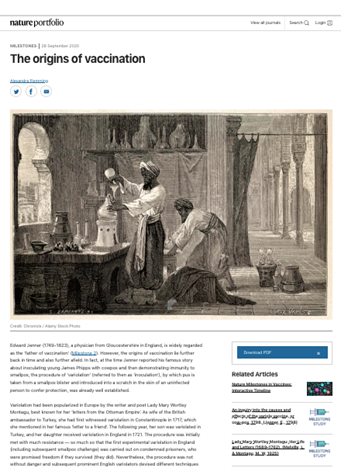 Caption: Alexandra Flemming’s briefing on vaccination’s origins outside of Europe, nature portfolio (2020)
Flemming recapitulates the modern history of inoculation and its origins which either lie in the islamic world or were mediated by it:
Variolation had been popularized in Europe by the writer and poet Lady Mary Wortley Montagu, best known for her ‘letters from the Ottoman Empire’. As wife of the British ambassador to Turkey, she had first witnessed variolation in Constantinople in 1717, which she mentioned in her famous ‘letter to a friend’. The following year, her son was variolated in Turkey, and her daughter received variolation in England in 1721. The procedure was initially met with much resistance — so much so that the first experimental variolation in England (including subsequent smallpox challenge) was carried out on condemned prisoners, who were promised freedom if they survived (they did).
Given the similarities between inoculation as practised in India and in the Ottoman Empire, it may be more likely that variolation, as described by Lady Montagu, had its roots in India, and it may have emerged in China independently. However, given that the ancient accounts of inoculation in India are contested, it is also possible that the procedure was invented in the Ottoman Empire and spread along the trade routes to Africa and the Middle East to reach India.
Regardless of geographical origin, the story of inoculation eventually led to one of the greatest medical achievements of humankind: the eradication of smallpox in 1980. And of course, it inspired the development of vaccines for many more infectious diseases, turning this planet into a much safer place. (Flemming 2020)
What do we learn from this overlooked history? The early campaigners and practitioners of variolation often came from the margins — geographically, socially, and epistemologically — and were predominantly women. In the Ottoman Empire, it was female healers who preserved and transmitted this knowledge, yet their contributions were rarely documented. Excluded from formal education institutions such as the madrasas, women had no access to the elite circles that produced official medical texts. As a result, their empirical expertise was systematically omitted from Ottoman medical literature. This epistemic erasure persists: modern medical science continues to privilege the written word, often treating knowledge that exists outside textual, institutional, or peer-reviewed frameworks as if it did not exist at all.
Bearing in mind that inoculation had been practised for centuries in the Ottoman Empire — which included the Balkans — it would not be far-fetched to consider that members of Ibrahim Hoti’s family, or his wider community, may have engaged in some form of traditional, do-it-yourself variolation. Practices involving the cowpox virus or other localised inoculation techniques may well have circulated informally, especially in rural areas. According to one source, such procedures were often performed by women, who inoculated entire villages at specific times of the year. These seasonal rituals suggest a community-based understanding of disease prevention, transmitted orally and through embodied practice rather than formal medical instruction. That this knowledge was rarely documented should not obscure its possible historical presence — particularly in regions shaped by Ottoman epidemiological culture. Mary Wortley Montagu describes in great detail, “how old women kept pus from a smallpox victim in a nutshell and used a needle to create a tiny scratch in their patient's vein.” (Brumfiel 2021).
If, indeed, Ibrahim Hoti rejected official Yugoslav vaccination, was it because he did not need it — having already been variolated — or because he wished to avoid inoculation by a state he did not trust, for religious, medical, or political reasons? The film shows no interest in such questions. The filmmaker could have visited Hoti’s village (now in a state that has declared independence but is not recognised by Serbia), spoken to his family, or sought local perspectives — but in Another Spring, Muslims are not given a voice.
Instead, the old tale that the virus hailed from an Arabic market and attacked through the body of a Muslim pilgrim, the sacred heartland of the Serbian Orthodox, Kosovo – in its Yugoslavian era underdeveloped and predominantly populated by Muslims?
One last thought on the “Arab pox”. If, indeed European Muslims have been familiar with the practise of an immunisation with a minor dose of the virus, this would mean that they were in a similar privileged position towards the Christians in the Balkans as were the Spanish colonisers of America to the indigenous whom they infected and almost liquidated via smallpox since the Aztek population had no immunity against the pox whatsoever. For the native Americans, smallpox brought to them by the European missionaries must have appeared to them as Christian pox.
Moreover, most “Christians” on the so-called enlightened European continent had no equivalent to the “Muslim” practice of variolation until the advent of modern vaccination — a method formalised only in 1796 by Edward Jenner, who used material from a cowpox pustule on a milkmaid’s hand.[18] The very term “vaccination” is, in fact, a nod to its bovine origins (vacca being the Latin word for cow). After the official eradication of smallpox in Yugoslavia by the early 1930s, the situation had not fundamentally improved when it comes to diagnostics. In 1972, doctors in Belgrade either failed or refused to recognise smallpox in a patient arriving from Kosovo. This form of modern, amnesiac scientific epidemiology proved tragically ineffective for those who had not been vaccinated — people who were then infected and left without a chance of survival. Others suffered harm as a result of being forcibly re-vaccinated multiple times while crossing internal borders en route to what was imagined as “Europe.”
Miranda Jakiša (2022) describes the vaccination practice on the “edge of Europe” as follows:
During the historic outbreak of 1972, the Yugoslav authorities, Radak writes, put up a check-point on the Danube bridge to Pančevo between Serbia proper and Vojvodina – a spot symbolically separating Europe from the East (Lazarević Radak 2019: 76). Whoever crossed the bridge, be it on foot or in cars or buses, was vaccinated by puncturing the skin with a bifurcated vaccine needle. People crossing this provisional border several times were repeatedly vaccinated, a procedure which in some cases damaged their health. Fears inspired by Orientalism, as Radak points out, fed on the notion that one was defending Europe’s outer borders with such overreactions.
In her analysis of the 1982 feature film Variola Vera (Goran Marković, Yugoslavia) Jakiša connects the guarding of this imaginary European threshold to an ancient Orientalist trope:
This bulwark rhetoric, present in the Balkans since the late middle ages (Berezhnaya and Hein-Kircher 2019) and intensely in use during the nation-building struggles against Ottoman rule (Kenneweg 2012), is expressed explicitly in the film in the above-mentioned WHO-letter praising Belgrade for defending the rest of Europe. However, the letter also leaves little doubt on where Yugoslavia is to be situated in this operation of mental mapping: “on Europe’s very edge” (“na samoj ivici Evrope”). Thus, the mechanism of (nestling) Orientalism works on several levels in Variola Vera: firstly, there is the “real Orient” (the non-situated market); secondly, parts of Yugoslavia are infected by this “Orient” (Kosovo and its Albanian minority); thirdly, this at the same time foreign and internal Orient threatens and succeeds to infect Belgrade; finally, for the WHO, this is all taking place at the outskirts of Europe, in a border-space which does not really pertain to the continent’s “core”. In other words, just like the “Eastern” threat is both internal and external to Yugoslavia, Yugoslavia is, following the logics of the “edge”, both internal and external to Europe: as the perspective moves “West” (from the market to the WHO) it incessantly carries its orientalising gaze with it. (Jakiša 2022)
A Muslim, Found and Publicly Named
If international festival audiences have accepted the Yugoslav narrative about Al-Hajji Ibrahim Hoti as Patient Zero at face value, one must ask: what impact might such a film have on viewers who already hold fixed views on Kosovo Albanians or on Serbia–Kosovo relations more broadly? The film’s implicit framing risks reinforcing entrenched prejudices. By presenting a Muslim Albanian pilgrim as the origin of a national health crisis — without offering his community any voice or historical context — Another Spring effectively reproduces a narrative that cannot but fuel hostility toward Albanian and Muslim minorities in Serbia and beyond. The title itself, Another Spring, evokes both March 1972 and March 2022 — the two pandemics it indirectly links — yet rather than opening a reflective space between them, the film recycles old scapegoats for new anxieties.
Kovačević (2022) enumerates his audiovisual sources as the “former TV Belgrade”, “Kosovo's TV Priština, the Army's Zastava Film and Yugoslav Newsreels.” Without any constraint he used material from all these archives which “had the footage from the period”, no matter whether the provenience was Serbian or Kosovar. He notes that this non-descript “diversity” led to “discrepancies in how the various pieces of footage looked” which the director apparently did not perceive as a chance to tell a more diversified, or, even, polyphonic story. Instead, he used a cinematic trick – slowing down the archival moving images by a third (“Other than slowing down the footage during more or less the entire film, we did not try to visually unify the material” Kovačević 2022).
In the process of sifting through ‘domestic’ AV archives (fully accessing Yugoslav era material), the film production was able to identify footage with the person chosen as scapegoat in 1972 and did so.
It seems that Serbian society has indeed changed in the last years. After all, the authors of the 2016 scientific article still had refrained from this form of public shaming which resulted in heaping disgrace on the name Hoti.
“The Red Plague” in 1972-1982–2022
Every effective propaganda feat always contains a measure of truth. What does become clear in Another Spring is that Tito’s Yugoslavia was neither well-equipped to handle the epidemic (vaccine as well as vaccination jet-guns came from abroad, the USSR and the USA) nor did it have an ideal vaccination status.[19] Cineuropa reviewer Vladan Petkovic is of the opinion that Yugoslavia managed the outbreak well – this is true compared to the high death count in Serbia during the Corona epidemic.
The way Kovačević ends the film clearly shows his standpoint and makes it clear why people trusted the authorities and medicine much more 50 years ago than they do today. What was nominally a non-democratic, communist state functioned a lot better, and in a far more humane way, than today's so-called democratic governments and their dependence on the "free market". (Petkovic 2022)
Clearly, not all people trusted the authorities. Even from the 2022 film it becomes clear that there are “people” who “trusted” and there are others who have less of a reason to trust the government, after all, “there are Yugoslavs and then there are other Yugoslavs.” (Jakiša 2022)
Another Spring does not hide the fact that the country in 1972 had too many unvaccinated or un-boostered citizens (especially young children)[20] and shows truthfully how the doctors failed to diagnose the first cases; we also learn that it took weeks to diagnose smallpox (or make light of the diagnosis)[21] and that there was a careless ignorance of the possibility of infection in the hospitals of the capital, Belgrade, where other patients were asked to help carry Mumdžić who was covered in spots and blisters to a different hospital. The film’s justification of the late diagnosis with the circumstance that in Yugoslavia smallpox had been eradicated since the 1930s, and therefore nobody remembered the symptoms, is alibistic, at best. A more plausible interpretation, especially in light of tense Soviet–Yugoslav relations at the time, would be that Tito feared publicly acknowledging a crisis he could not contain, one that might trigger Brezhnev’s “brotherly” intervention.
Why does this highly suggestive film, produced in 2022, fail to address any of these questions?
In an interview, Kovačević merely mentions the positive role “Russia” played in the eradication of smallpox:
On a wider scale, when the programme of smallpox eradication started in 1967, the proposal came from the USSR, and all members of WHO agreed to it. “It was the Cold War era, but no one said, ‘We're not going to do what Russia says’,” the director points out. “These scientists, regardless of what the political relations were between their countries, managed in ten years to eradicate the most dangerous disease in human history, which had killed more than half a billion people in the 20th century alone.” (Kovačević 2022) Mladen Kovačević • Director of Another Spring - Cineuropa
Aside from the fact that this was the Soviet Union, not “Russia,” the documentary’s director appears to have placed unquestioning trust in a single medical authority — without engaging in basic historical fact-checking.
By basing the documentary almost entirely on a single source – Radovanović’s popular science book written during the refugee crisis in 2016 – and his voiceover, I could not see where the “thriller” element lies for domestic audiences, respectively, all those who have seen the 1982 fiction film Variola Vera or one of the documentaries on the topic.[22] Another Spring relies heavily on these earlier representations, both fictional and non-fictional, effectively functioning more as a remake than an original investigation. One possible motivation for this repetition may be to promote COVID-19 vaccination — a laudable goal in itself — yet the film simultaneously forecloses any critical engagement with the possibility of bioterrorism, thereby serving local political and ideological agendas. These include undermining Kosovo’s independence, reaffirming — half a century later — the Yugoslav-era scapegoating of an “alien” figure, regardless of the fact that Ibrahim Hoti was a Yugoslav citizen and most likely had no causal link to the outbreak. In doing so, the film risks inciting posthumous hostility toward its Patient Zero — recast as the figure of the Eternal Muslim.
A comparably critical perspective on the spring of 1972 is entirely missing from Another Spring. Instead, in the end we see smallpox survivors, marked with scars, thanking Tito. I was wondering whether Kovačević – whose film begins in a similar Orientalist setting as Variola Vera – was aiming at a contemporary remake as well as ‘correction’ of the 1982 feature, which was not only critical of the Yugoslavian health system but also ironicised the motif of the ‘oriental’ origin of the disease when, in the last shot, it shows the virus-carrying flute in the hands of a clueless apparatchik (who, as we can assume might have just infected himself…).In several respects, Another Spring is surprisingly derivative, though this could be interpreted as a documentary-mode dialogue with Marković. This gesture is undermined by the fact that the 2022 film harbours a latent disdain for those perceived as different from the majority population, exemplified by the disparaging remark about “anti-modern” burial customs in the village allegedly preventing Latif’s autopsy.
It is worth noting that the only element Another Spring does not borrow from Variola Vera (1982) is the sexual one. Variola Vera included several workplace sex scenes — often reproducing conventional gender hierarchies (male doctor, female nurse) — reminiscent of another late socialist epidemic film, Věra Chytilová’s HIV tragicomedy Kopytem sem, kopytem tam (Tainted Horseplay, ČSSR, 1988). Both feature films offered political critiques of socialist societies and how they mismanaged crises, often resorting to information embargoes: whether during the 1972 smallpox outbreak in Yugoslavia (reportedly to protect the tourist season) or the nuclear disaster at Chornobyl’ in the USSR. In both cases, concealment became untenable once foreign observers gained access to data — be it infection rates or radioactive fallout. Another Spring does not achieve any critique of that kind.

As a conclusion, one must return to the origin of Another Spring. In an interview, director Mladen Kovačević recalls how, during the COVID-19 lockdown, he was inspired to make the film after reading Zoran Radovanović’s book on variola — a work that, notably, includes the gratuitously racist phrase “Arab pox.” It seems that this very term may have “infected” the director himself. Rather than interrogating such language, the film reanimates the old Orientalist trope that variola vera was a “Muslim plague.” In doing so, Another Spring fails to offer new insight. It sidesteps deeper questions: Was Yugoslavia in 1972 possibly used as a test site for a deadly virus? Why did the outbreak begin in Kosovo? Was this location coincidental, or part of a larger political strategy aimed at weakening Tito’s regime by exacerbating the so-called “Muslim question”? These questions — urgent, uncomfortable, and unresolved — remain unasked and unanswered.
References and Footnotes©Nataša Drubek, FILMOVI.hr, 7. veljače 2026.